Published on: 7 October 2026
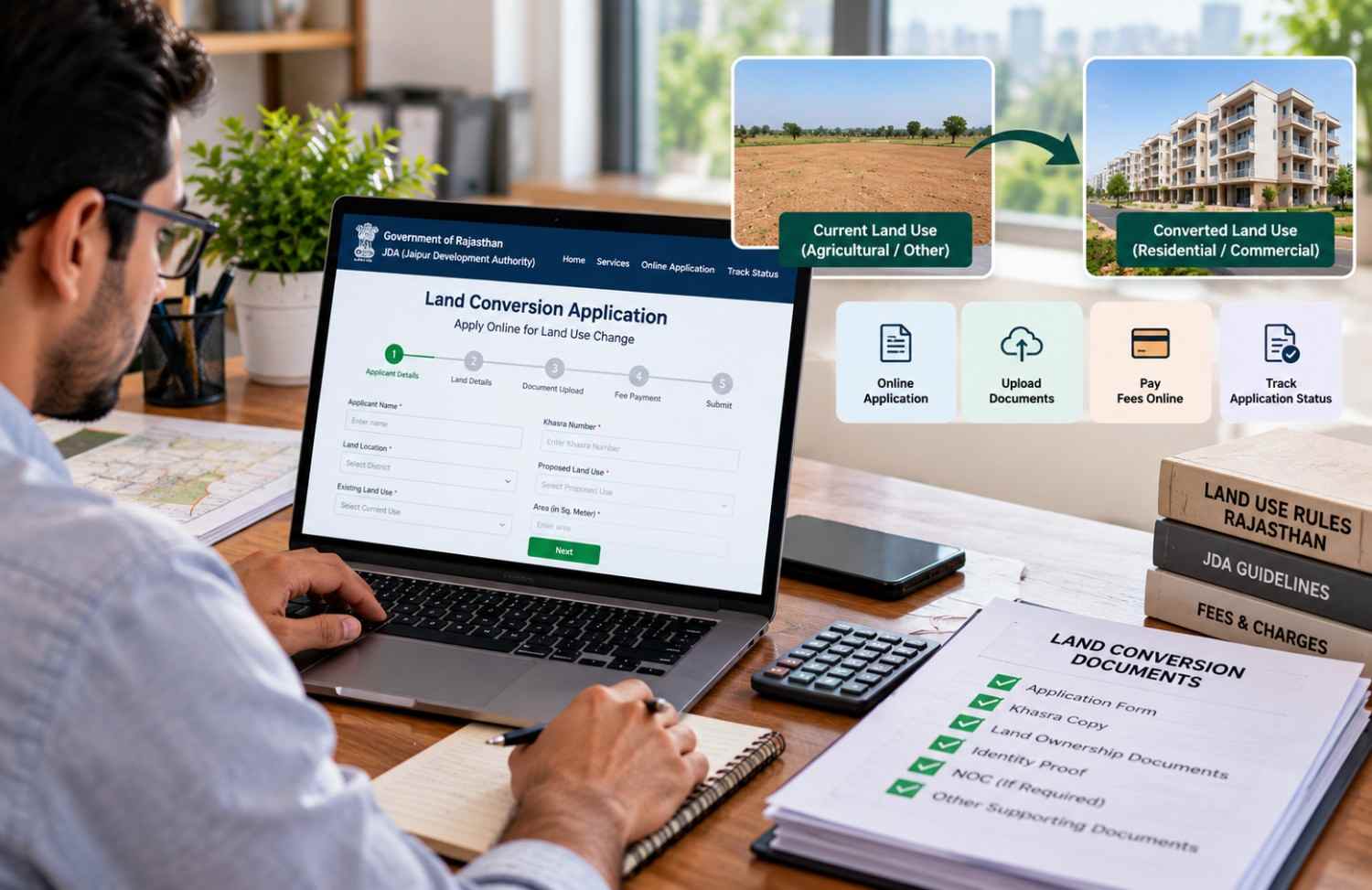
The land conversion rules in Rajasthan 2026 regulate the conversion of agricultural land for residential, commercial, industrial and other non-agricultural uses. Applications will be processed online, with fees starting at ₹2,000 for residential units and ₹20,000 for other uses. Applicants need ownership records, Jamabandi and other required documents. The new rules are scheduled to take effect from November 2, 2026.
Converting agricultural land into residential, commercial, industrial or other non-agricultural use is an important legal step for landowners in Rajasthan. With the state moving towards a fully online and automated approval method, understanding the land conversion rules in Rajasthan has become particularly important for anyone planning construction or development on agricultural land.
The 2026 structure is designed to simplify the process and reduce delays by shifting applications and approvals to an online platform. According to ETRealty, the new system will also facilitate automatic generation of permission orders after the required documents and proof of premium payment are submitted.
Land conversion rules determine when and how agricultural land can legally be used for a non-agricultural purpose.
For example, if agricultural land is intended to be used for a residential building, commercial establishment, industrial project, hotel or other permitted activity, the applicable conversion method must be followed.
The new Rajasthan 2026 rules specifically govern the conversion of agricultural land for non-agricultural purposes in rural areas. They have been notified by the Revenue Department and are scheduled to come into force on November 2, 2026.
There is an important timing point for landowners. As of October 2026, the new rules have been notified but are scheduled to become effective from November 2, 2026. Therefore, anyone filing around this transition period should verify which framework applies to their application and the applicable portal requirements before making payment or starting development.
The biggest change is the shift from a largely traditional approval process to an online and automated system.
Under the new framework:
This digital approach is intended to make the conversion process faster and more transparent.
Not every agricultural parcel can automatically be converted. The land must satisfy the applicable legal and location-related conditions.
Generally, applicants should verify:
The 2026 framework retains restrictions on several categories of land, including land under acquisition, protected or eco-sensitive areas, water bodies and catchment areas. Certain areas affected by heritage laws, road and railway corridors, defence installations, petroleum facilities and other critical infrastructure may also be restricted.
One of the most important points in the new system is the difference between the application fee and the conversion premium.
Under the notified 2026 framework:
| Application Type | Application Fee |
|---|---|
| Residential unit | ₹2,000 |
| Other Purposes | ₹20,000 |
These are application fees and should not be confused with the conversion premium payable for changing the land use.
The conversion premium depends on the proposed use of the land and is largely linked to the applicable DLC rate.
The notified structure reported for the 2026 framework includes:
| purpose | Indicative Premium |
|---|---|
| Residential use | 5% of applicable DLC rate |
| Public utility / industrial use | 5% |
| Commercial use | 10% |
| Institutional / medical use | 10% |
| Food-processing units | 2.5% |
| Renewable energy projects | 0.5% |
The exact amount payable should be calculated according to the applicable category, land area and current DLC valuation.
Certain eligible categories may receive complete or partial exemptions. Tourism units, stadiums, playgrounds and sports complexes, for example, are among the categories reported to receive full premium exemption under the notified framework, subject to applicable conditions.
Applicants should prepare accurate and updated documents before starting the application.
The Rajasthan Revenue Department’s land-conversion portal document list includes:
Depending on the project and proposed use, additional permission, plans or supporting documents may also be required.
The new online system is intended to make the process more straightforward.
First, verify ownership, Jamabandi, khasra details, land category and whether the property falls within any restricted area.
Clearly determine whether the land will be used for residential, commercial, industrial, institutional, medical, renewable energy or another permitted purpose.
Collect the latest revenue records, registered deed, revenue map, layout plan where applicable and identification documents.
Submit the land conversion application through the designated online system and upload the required documents.
Pay the prescribed application fee and applicable conversion premium. The amount depends on the proposed use and applicable DLC-based calculation.
After the prescribed requirements are fulfilled, the system is designed to generate the permission order automatically under the new framework.
Following approval, the land-use classification is expected to be updated in the revenue records through the streamlined system.
Conversion approval does not mean that every part of the land can be freely developed.
For residential colonies and projects, the rules include land allocation requirements for roads and public facilities. The existing framework provides for 40% of total land to be reserved for public facilities, including roads, with the remaining area used for the residential project subject to the applicable conditions. Industrial development also has prescribed land-use allocations for industrial activity, infrastructure, open areas and supporting facilities.
Therefore, developers should consider both land conversion approval and project planning requirements before beginning construction.
The new system can make rural land conversion more convenient by reducing physical paperwork and administrative delays.
For buyers and investors, proper conversion can also provide greater clarity about the permitted use of a property. This is particularly relevant when evaluating agricultural land for future residential, commercial or development purposes.
If you are researching property opportunities alongside land-use regulations, resources such as Search Abode can also be useful for understanding the broader real estate market and property options.
The land conversion rules in Rajasthan 2026 represent a significant shift toward online, streamlined and automated approval of agricultural-to-non-agricultural land use in rural areas. With the new rules scheduled to take effect from November 2, 2026, landowners and developers should understand the applicable fees, DLC-linked premiums, eligibility conditions and documentation requirements before applying.
Most importantly, land conversion should be treated as a legal and planning requirement rather than just a paperwork exercise. Verify the property's revenue records, restrictions, proposed use and applicable charges before making construction or investment decisions. Since rules and fees can be updated through government notifications, applicants should also confirm the latest requirements through the Rajasthan Revenue Department before submitting an application.
The application fee is ₹2,000 for residential units and ₹20,000 for other purposes. A separate conversion premium may also apply based on the land use and applicable DLC rate.
Under the 2026 rules, eligible applicants can apply through the designated online land conversion system by submitting the required documents and paying applicable charges.
Common documents include the latest Jamabandi, registered sale deed, revenue map, identification documents and applicable layout plans.
For residential use, the conversion premium is generally linked to the applicable DLC rate, with the notified 2026 framework providing a 5% premium for residential use, subject to applicable conditions.
Yes, eligible agricultural land can be converted for residential use after complying with the applicable land conversion rules, restrictions, documentation and payment requirements.
Under the new 2026 framework, the Sub-Divisional Officer (SDO) is the prescribed authority for the applicable rural land conversion process.